
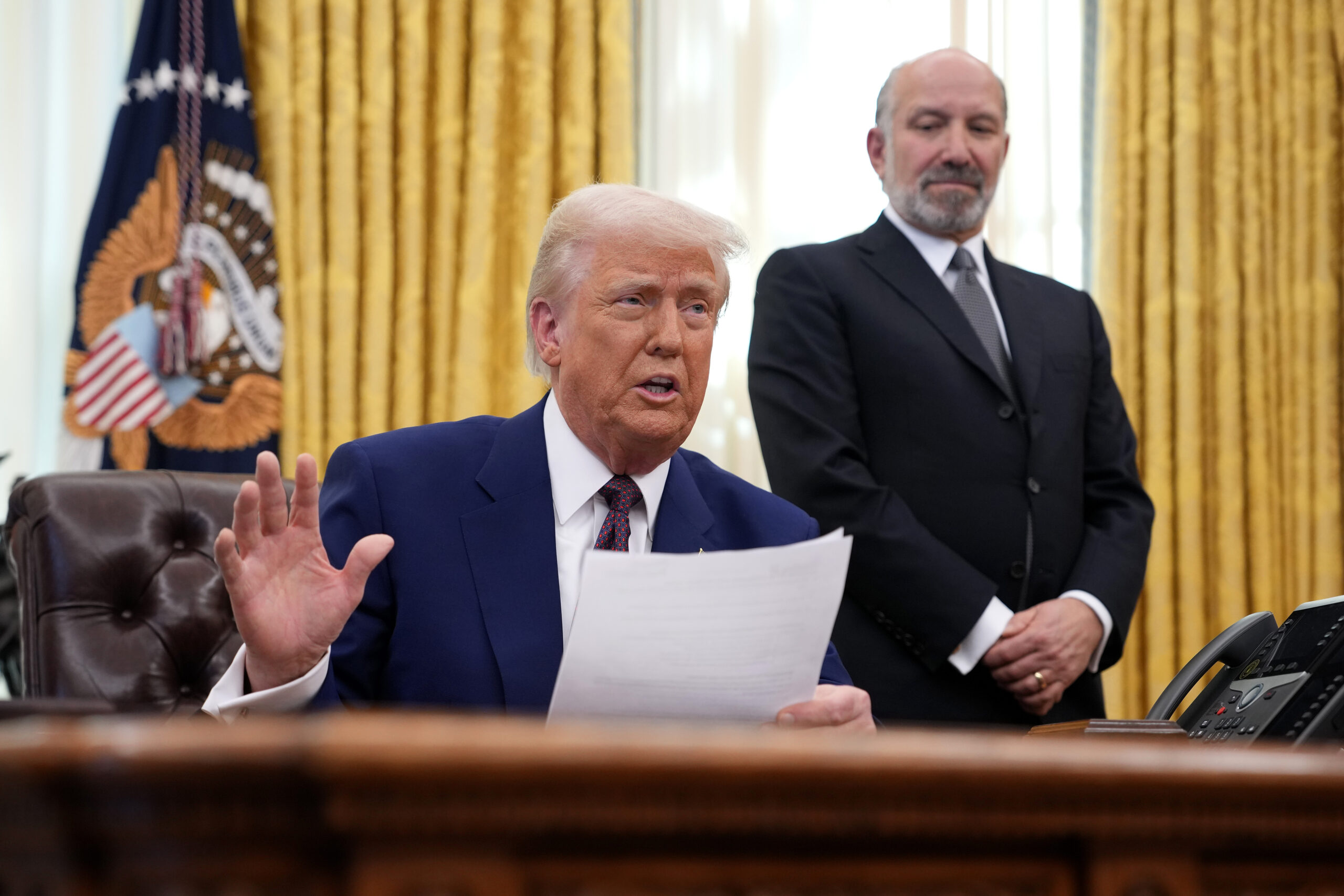
A highly unusual Census Bureau report that President Trump is using to reup dubious claims of widespread illegal voting by non-U.S. citizens has ties to a Trump-aligned think tank, NPR has learned.
Read more Iraq is caught between Washington and Tehran
In a social media post Tuesday, Trump claimed that the bureau’s initial analysis of more than 128 million voter records “proves that over 24,000 Noncitizens voted illegally” in the 2020 presidential election and that the final number will “explode” after the statistical agency finishes checking over 32 million more voter records.
The unauthored, seven-page report says it draws on a 2020 commercial voter file and various federal administrative records, but data and election experts say the report is questionable in its methodology and conclusions.
Work on the analysis was not conducted by career civil servants at the Census Bureau, and the team behind it included individuals affiliated with the America First Policy Institute, a think tank started by officials from Trump’s first administration, according to a Census Bureau employee who NPR has agreed not to name because they fear retaliation at work.
Spokespeople for the bureau, the America First Policy Institute and the White House did not respond to NPR’s requests for comment.
But AFPI highlighted the analysis in a social media post Tuesday, saying that the think tank “maintains that maximizing transparency is a critical step to restoring confidence in our elections.”
The report is the latest attempt by Trump officials to push baseless claims of widespread voter fraud
Trump continues to falsely claim the 2020 election was rigged, and in the final stretch before this fall’s midterm election has urged his Republican allies in Congress to pass sweeping new voting restrictions.
The numbers from the Census Bureau report join a growing list of figures the Trump administration has released in recent months. The figures use disputed or unknown methodology in an attempt to quantify noncitizen voting in federal races, a problem many studies and audits show is incredibly rare.
Elections
Trump’s claims of 250,000 non-U.S. citizens on voter rolls leave some states baffled
Last month, the Department of Homeland Security announced it had found 250,000 noncitizens on public voter rolls in California, Nevada, New Jersey and Pennsylvania, but it has yet to publicly disclose how it made those calculations. And election officials in those states expressed doubts about the accuracy of the claims.
The latest numbers from the Census Bureau report have also drawn pushback from election experts.
“This analysis is laughable. Census data cannot reliably be matched to voter data,” David Becker, executive director of the Center for Election Innovation & Research, said in a text exchange with NPR. “That said, it’s good to see the president admit these numbers are so small that they couldn’t have changed the outcome in 2020.”
Using figures from the initial analysis, some 24,000 votes out of 128 million is just shy of 0.02%.
Michael Morse, an assistant professor at the University of Pennsylvania’s law school who has researched voter registration files, echoed Becker’s criticism over email, writing: “I’d expect that the Census data matching [exercise] is plagued by the lack of unique identifiers in voter records and outdated or incomplete naturalization records. But the brief’s lack of transparency makes it difficult to pin down each problem or trust any explanation. Regardless, the estimated rate of apparent non-citizen voting is both a tiny fraction of total votes … and entirely consistent with both types of error.”
Read more Data shows women are leaving the workforce. What does that say about the economy?
The report threatens the Census Bureau’s reputation as a nonpartisan statistical agency
Former employees of the Census Bureau are also raising alarms about the report.
“My biggest concern would be there’s no author attached to the report, which is not common practice within the Census Bureau,” says Misty Heggeness, a former bureau economist whose work is cited in the report. “Usually there are layers and layers of rigor and testing because the Census Bureau is a neutral statistical agency. They want to make sure that they’re getting it right and understanding the data. The fact that there’s no author on this report leads me to wonder whether or not that did happen.”
Politics
A Trump push to cut ‘statistical noise’ could mean less data from the Census Bureau
As a former chief of the bureau’s Center for Administrative Records Research and Applications, Amy O’Hara points out the risk of generating an inflated number of noncitizen voters by mismatching voter files with citizenship records from other federal agencies.
“This brief lacks any sort of measures of variance or discussion of bias,” says O’Hara, who now directs Georgetown University’s Massive Data Institute. “While those matches were found, were they the same people between the voter file and the compilation of data from Homeland Security, or do you have people with the same names potentially living in the same state and representing a mismatch?”
O’Hara was also taken aback by the report’s claim that the bureau is “uniquely capable of compiling and publishing statistics on election crime and other forms of fraud.”
“I found that very surprising because even if they observed anomalies in the data, those anomalies aren’t necessarily fraud,” O’Hara says.
The report’s release comes after a major brain drain of statisticians, economists and other career civil servants at the bureau following the Trump administration’s slashing of the federal workforce.
The administration has also been signaling it’s preparing to propose major changes to the 2030 census that are likely to put the bureau in the center of another major political and legal fight.
O’Hara sees the report as another threat to the bureau’s reputation as a nonpartisan statistical agency.
“We are drawing in on the 2030 census that really requires the participation of everybody in the country. Anything that casts a negative light on the Census Bureau’s motives or operations or transparency or lack of adherence to policy could be detrimental,” O’Hara says.
With the report’s title — “Noncitizen Voting in the 2020 Election, A Beginning Analysis” — suggesting similar reports are on their way, Heggeness, the former bureau economist, says the country should be vigilant.
“It’s a confusing time for the public. I think it is really hard for the public to trust what’s coming out of the administration, the data that they’re seeing,” says Heggeness, who is now a professor of public affairs and economics at the University of Kansas. “This document really does have a lack of a source and citations and explanation about methods. And if the public sees a document like this that lacks all of those really integral pieces that are generally put out with official statistics, that’s a really good sign to question the validity of the document.”
Read more The U.S. debt tops a record-shattering $40 trillion. Yes, with a T.