
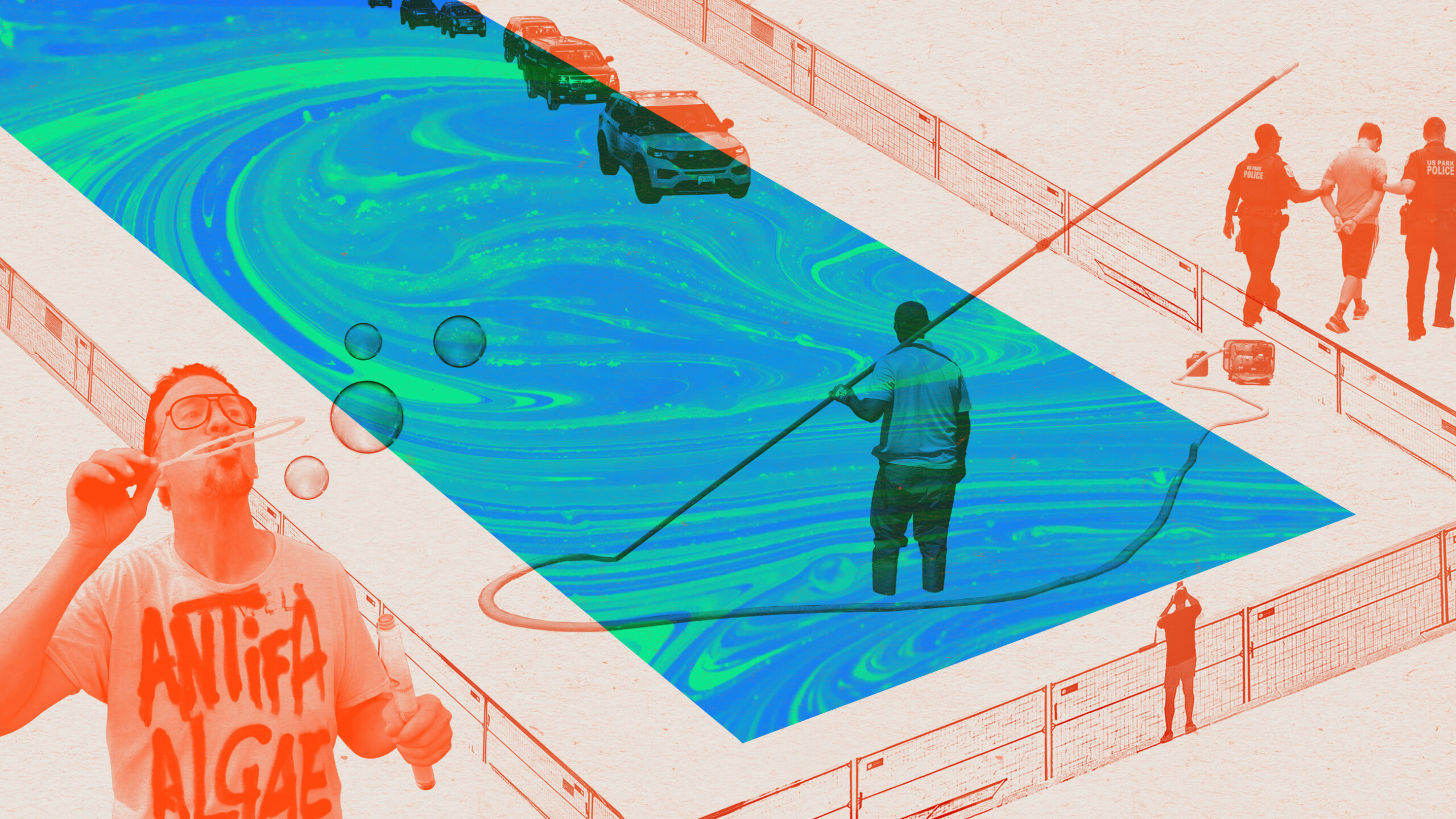
Of the many political dramas unfolding on any given day in the nation’s capital, one character has emerged as an unlikely star: the Lincoln Memorial Reflecting Pool.
Read more Independent autopsy “inconclusive” on cause of death for 18-year-old Nolan Wells in Mississippi
The shallow, rectangular landmark has been the site of historic speeches and presidential inaugurations over the decades. But now, at age 104, it’s taken on a new national significance as the site of the Trump administration’s embattled beautification efforts — and the criticism, misinformation and mockery that’s ensued as the months drag on.

National
The many ways Trump wants to change D.C., from buildings to statues to parks
“The reflecting pool is sort of the perfect fodder for hate-watching in real life, because it is something that keeps unfolding,” said Danielle Lindemann, a professor of sociology at Lehigh University and the author of
President Trump said in April that it would take about two weeks and $2 million to resurface the pool in “American flag blue,” to address leaks and freshen its appearance ahead of D.C.’s Fourth of July celebrations. The price tag has since ballooned to over $14 million, and more than two weeks after Independence Day, the pool is empty and fenced off from the public.
There have been plenty of twists and turns along the way.
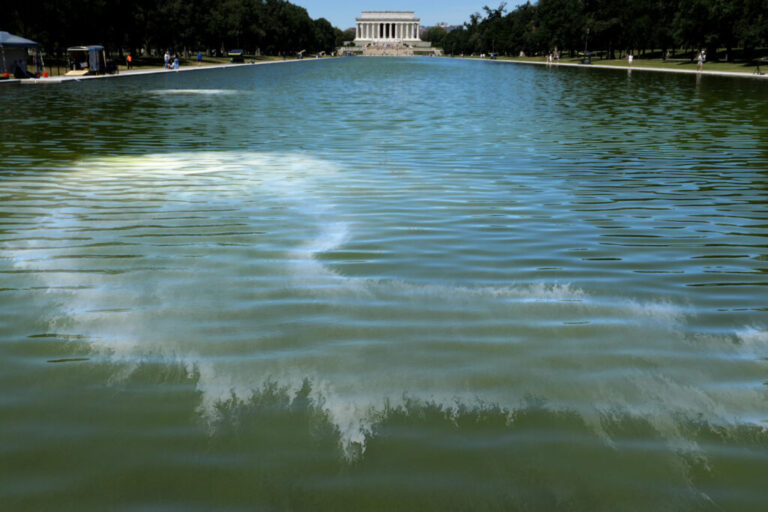
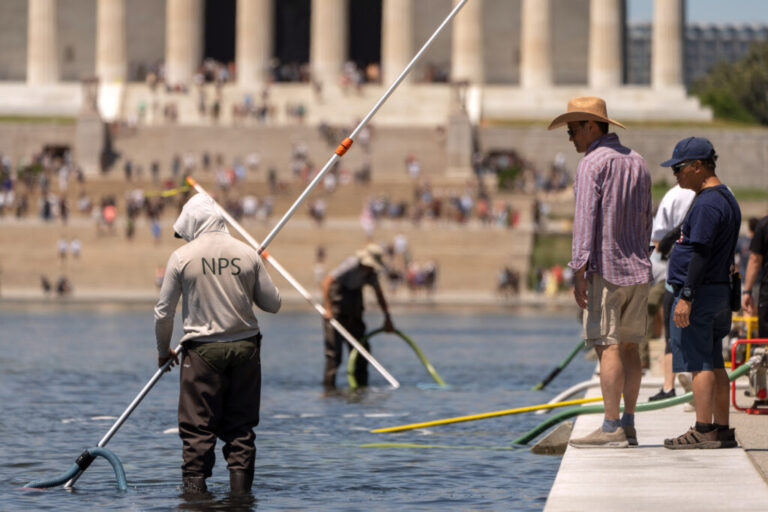
Days after the pool was refilled in June, algae blooms turned the water bright green. Workers tackled the blooms with hydrogen peroxide and oversized vacuums as anti-Trump protesters — including one in an inflatable pink frog costume — showed up to rally for “Team Algae.”
“The reflecting pool is a reflection of the incompetence of this regime,” said Nadine Seiler, one of those protesters. “And people are just taking potshots because it’s … so absurd that it’s funny.”
National
Algae clouded Trump’s vision for the Reflecting Pool. But scientists aren’t surprised
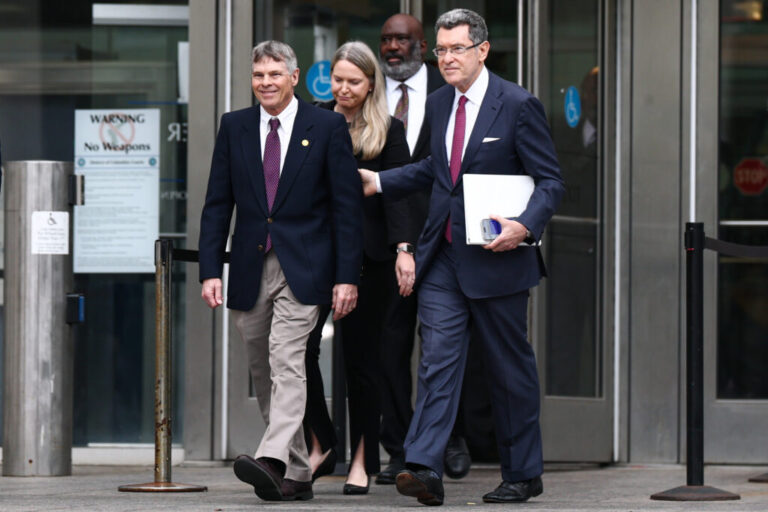
Pieces of the new blue lining peeled off in chunks, for which Trump blamed box-cutter-wielding vandals. Several people were arrested, and one — former U.S. Olympian David Hearn — was indicted (he pleaded not guilty to a felony count of malicious destruction of property). But critics, and a recent investigation, blame a flawed paint job by the Trump-friendly firm that won a controversial no-bid contract for the project.
The administration says it is using the same firm to repair the pool, which was drained of water and fireworks debris after July Fourth. And, at Hearn’s most recent hearing this week, a federal judge warned that the government is “operating at its own peril” if it continues with repairs before Hearn’s attorneys can collect evidence.
All to say, the plot keeps thickening.
“People might see it as a brutal metaphor for the failures of the administration … literally murky and changing color,” Lindemann said. “How can you look away from that?”
It turns out, many people can’t. The pool has dominated headlines and social media feeds, helped by a handful of D.C. bloggers and influencers who have made it their mission to document the unfolding saga.
People are flooding their comment sections from afar with questions, condolences and claims of AI manipulation. U.S.-based Google searches for “reflecting pool” are up more than 5,000% from a year ago. A recent column declared: “At this point, the Reflecting Pool deserves an Emmy.”
The reflecting pool drama resembles reality television in many ways, according to experts who have studied it. For one, it has relatively little impact on most people’s daily lives, said Aram Sinnreich, a professor at American University’s School of Communication.
“Your average human being is not at all affected by how much algae is in the reflecting pool or whether there’s a tear in the lining or what color it is,” Sinnreich said. “And so it feels like a kind of consequence-free form of entertainment … during a time where everybody is really stressed out.”
National
Former Olympian pleads not guilty in reflecting pool vandalism charge
It’s a source of memes, a conversation starter, a form of escapism from heavier headlines about global conflict and climate change.
But, he says, it’s also a microcosm of many issues critics have with the Trump administration, from its perceived disregard for expert input to financial dealings with political allies.
“Even though the subject matter is trivial, the debate is not trivial,” Sinnreich added. “When people talk about the reflecting pool, what they’re really talking about is a referendum on the Trump presidency itself.”
Lindemann agrees that the pool stands in for something deeper: “It is much easier to focus on cracks in a pool than maybe cracks in democracy or other major geopolitical issues.”
Whose version of reality?
Trump starred in a hit reality series long before he lived in the White House. Lindemann calls him the “reality TV president,” pointing to his penchant for nicknames and dramatic reveals.
“I think we see that with the pool too, where he is driving an SUV over the pool and then dramatically getting out like he’s a contestant in ,” she said, referring to the presidential motorcade’s trip across the partially resurfaced pool in early May.
Reality TV is widely understood to be heavily manufactured, shaped by everything from casting to editing. And that’s primed audiences not to believe everything they see on their screens, she says.
“Trump, throughout his political career, has been really effective at harnessing that skepticism about what we are seeing,” Lindemann said.
Politics
Trump claims vandals damaged D.C. Reflecting Pool, and says it will be drained again
Official government social media accounts shared photos of a blue reflecting pool in the days after it was refilled, even as observers noticed it turning green. The administration maintains that vandals slashed a gash — of varying lengths, from 250 feet to 300 yards — in the pool’s foundation, but has not released any clear evidence. Some Trump critics shared photos of what they say are tire tracks in the newly-drained pool, suggesting it was Trump’s own motorcade that actually caused the paint to eventually peel.
It’s against that backdrop that a number of D.C. photographers and influencers have taken to sharing near-daily updates from the pool, a project many began when it was only supposed to be a two-week endeavor.
Read more What forecasters expect this hurricane season, as Tropical Storm Bertha edges along
“It didn’t make any sense to me at the time, like why you would mess with the reflecting pool, which was fine the way it was,” said Joe Flood, who has visited the pool almost every other day since April. “They’ve screwed it up in a way that I could have never anticipated.”
As he spoke, looking down from the steps of the Lincoln Memorial on Monday morning, the pool was mostly empty except for a long stripe of water collected in the middle and several people walking across, seemingly inspecting the surface.
It remained surrounded by cameras and fenced off from the public. Flood walked his bike closer to the fence to snap some photos with his camera, which he promptly shared with his more than 18,000 followers on X.
“I like to get pictures of the condition every couple of days just to show people what’s happening and have a record of what’s going on,” he said.
Flood is motivated in part by his own opposition to the pool renovations and by the misinformation he sees online. He points to photos the White House has shared of the pool looking cleaner and bluer than it did to his own eyes.
“You could just look at it and see that the pool was too wide or was too blue, and people were retweeting it like it was a real picture,” Flood said. “And so that’s part of the reason I came down here, to take photos showing the slop that they were putting out there was not real.”
Flood views his audience primarily as people who no longer live in D.C. but still care about it. But his reach is far wider: He says one of his reflecting pool tweets got 2 million likes, and he gets impassioned comments from both sides of the debate.
National
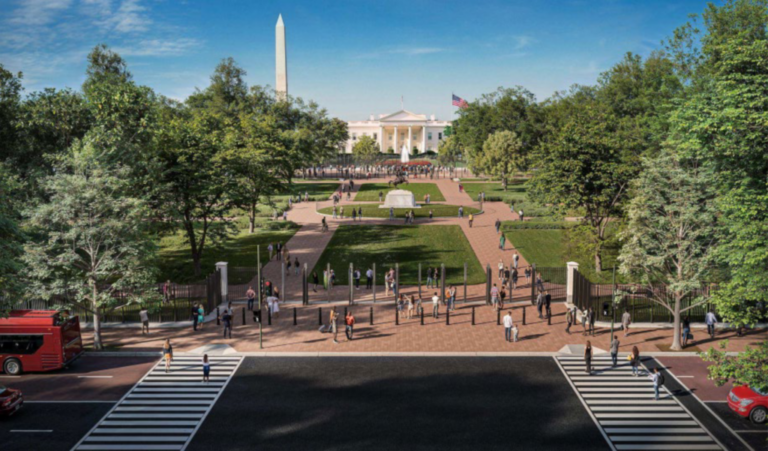
Trump wants a permanent fence around the D.C. park known for White House protests
“I think it really resonated among people who hate Trump because it shows that he’s screwing everything up, and it resonates among people who love Trump because they don’t want to believe the truth,” he said.
Others, he theorizes, may simply be entertained by the repair process itself. He compares it to a home improvement show: “HGTV for the capital.”
“We’re living inside the documentary”
While people may be consuming the pool drama like a reality show, Sinnreich says the locals covering it aren’t taking creative liberties like reality TV producers do.
“They’re much more akin to photojournalists or television journalists in that they understand there’s a subject of national or international interest, and they’re showing up with boots on the ground to point a camera at it day after day,” he said. Indeed, many of them are photographers or journalists by trade.
Sinnreich says we’re in a “large-scale crisis of trust in the media sphere,” where Trump’s attacks on mainstream media and the rise of AI have widened the lane for individual journalists and content creators. Like with reality TV, he says, viewers should keep their guard up as they scroll.
National
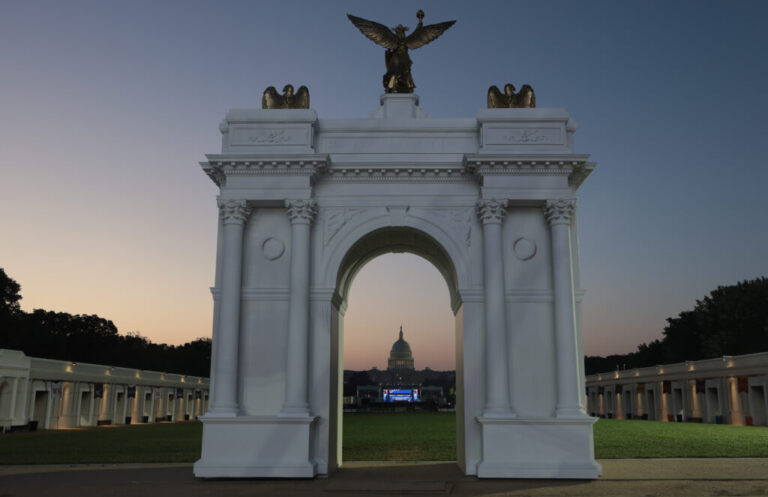
Trump’s arch clears another hurdle, setting up a big debate: Do height limits apply?
Some of the accounts that post regularly about the pool explicitly lean left or right, even as they offer fact checks and peeks behind the tarp. One of the most prominent conservative-leaning journalists covering the pool, Emily Miller, declined NPR’s interview request, saying, “I think my work can stand alone.”
Miller calls herself “the running reporter” because she’s a certified personal trainer who often reports from the pool in workout attire. Other “pool influencers” also deal in lifestyle content.
“When I started Instagram, I swore I’d never be political. And now people are telling me I’m way too political,” said Laurie Collins, who shares scenes from the nation’s capital as dccitygirl, where she has over 180,000 Instagram followers.
Collins, a lifelong D.C. resident and retired systems engineer, gained a following with photos she took on walks: colorful residential streets, blooming flowers, storefront Christmas decor. But as the Trump administration put its mark on the city, her photos show new slices of daily life: National Guard troops on the street, construction barriers surrounding the National Mall, algae in the reflecting pool.
Collins visits the pool every few days, driving past the Kennedy Center each time to check whether the tarp is still up. She says she feels lucky to be able to see these landmarks with her own eyes and act as a “trusted source” for her followers across the country and as far away as Australia.
“We’re living inside the documentary that people, I think, are going to study 100 years from now,” Collins said. “You either show up and participate and document, or you look away and hope it resolves. And it’s not resolving.”
Collins says she gets messages and comments from people who want to know what the pool looks like on any given day, or fact-check some trending post they saw elsewhere online.
Why does she think people beyond D.C. care so much?
“Because they care about our democracy,” she said. “It’s all entwined.”

1A
‘If You Can Keep It’: The Power Of Dissent In 2026
Collins says she has gained followers for her pool coverage. Many agree with her, bemoaning the state of the pool, D.C. and the country. But she’s also lost some followers, who have accused her of posting fake photos and being too harsh on Trump.
Collins said some people even told her to “stop posting about this and go back to your pretty pictures.” As much as she wants things to go “back to normal,” she views her role differently now.
“We are not a postcard. We are a city of people who live here,” Collins said. “To document what is happening to our city, I feel, is very important. And if I lose followers because they want my pretty pictures, then so be it.”
Read more Greetings from Jerusalem, whose holy sites host some of the oldest colonies of nesting swifts