
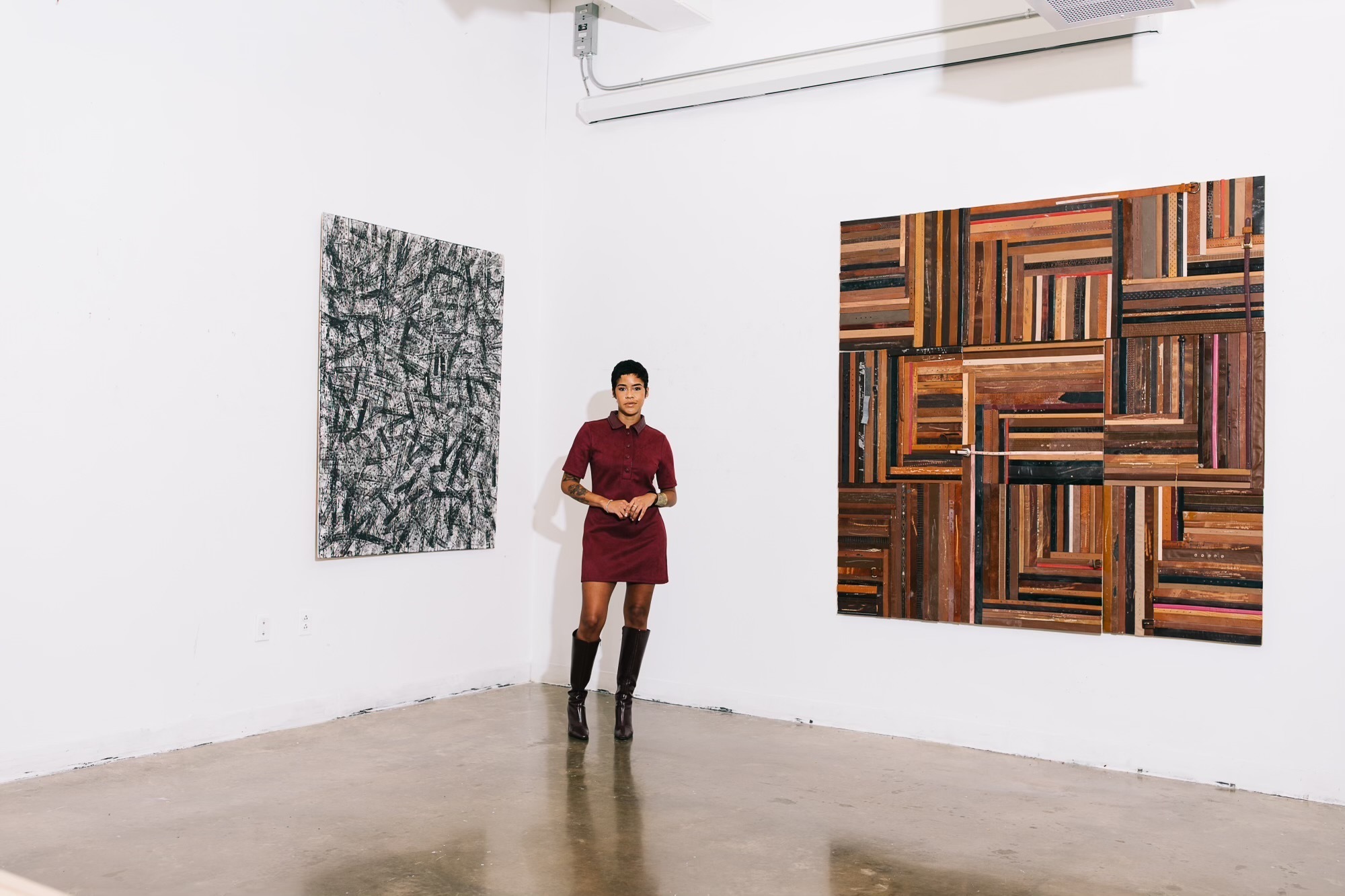
Multidisciplinary artist Lex Marie has gone viral on TikTok and Instagram for her artwork confronting discipline within Black households.
Read more Is it a renter’s market? It depends on where you live
At Lex Marie’s art studio, a belt is no longer just a belt.
I met the multidisciplinary artist in Washington, D.C., at the American University’s Katzen Arts Center.
She led me to her studio, where some belts are stretched across a canvas in meticulously organized rows and columns.
Others are used as a tool. Marie dips them in paint and swings them like a brush, leaving thick, violent marks across a white canvas.
Marie says each piece of work carries a story about childhood, discipline, survival and the complicated ways love can be expressed.
She is building a body of work that confronts a topic many families know well but rarely discuss openly: corporal punishment in Black households.
“I’m critiquing discipline in Black households specifically,” Marie says. “But I’m trying to tackle the history behind discipline in black households, behind spankings and whippings, and speak to the difference in how millennials are raising their children as well.”
The work is personal for her. Marie is 33 and the mother of an eight-year-old boy. As her son continues to grow, she says the questions that shape her art often come directly from her parenting.
“Through motherhood, I’m starting to think about my own childhood, and I’m comparing and contrasting it. So some of these works are just speaking from my experiences with spankings, and they’re also going from the perspective of how I feel.”
One of the larger works in the series is called “Watch Your Tone.” The six-by-six-foot piece is composed entirely of belts — dozens of them — arranged carefully across the canvas. They are an assortment of different shades of brown, black and pink to represent the color of flesh.
The title of the piece echoes a phrase many children hear growing up: “Watch your tone when talking to me.”
But Marie says the belts also represent something deeper.
She explains that she created this piece to convey multiple meanings. The different skin tones help her explain the different ways punishment is tied to American history.
For some historians and scholars, the conversation around corporal punishment in Black American households cannot be separated from the legacy of slavery. During enslavement, physical violence, such as being beaten with whips, was used to control Black bodies. Over generations, those discipline practices have evolved into modern parenting practices.
Yohuru Williams, founding director of the Racial Justice Initiative at the University of St. Thomas, believes that the link between corporal punishment and African Americans is rooted in slavery.
“This idea of whipping, this idea that black bodies require extreme punishment — that there’s something about the constitution of blackness that requires excessiveness in terms of discipline — has deep roots. Roots that extend beyond slavery. But it [was] really reinforced by the enslavement of Africans. And then once they come to the United States, you have this adoption of punishment systems within slavery that continue after slavery; that continue that process with that practice of brutalization of … black and brown bodies,” he said.
Read more Is a transparent fish the future of brain science? This center is betting on it
“Because I Love You, another piece in Marie’s series, highlights the physical act of enforcing punishment.
Marie painted a wooden panel white, dipped a belt in acrylic paint and struck the surface again and again, leaving marks scattered across the piece like scars and welts.
“I spent hours just kind of beating the same thing over and over,” she said.
The process left her physically sore the next day.
The piece’s title comes from a phrase many children hear after a whipping: “This hurts me more than it hurts you” or “I’m doing this because I love you.”
Marie explains how making this work has been cathartic and difficult. When the videos of her art began circulating online, the reactions were immediate.
Thousands of people commented on her post, sharing their own childhood stories. Some were painful and defensive, while others were grateful the topic was being discussed.
But Marie stands firm that the goal of this work isn’t to accuse or shame. It creates space for a conversation that is often buried.
Williams says that in order to have these discussions, Black families have to reimagine how they think about discipline.
“I think a lot of parents — black parents — struggle with this because there is this inherent knowledge that this is the way that we came up. And there is this belief that, well, you know, … maybe we’re more stable, maybe we’re more durable, maybe we’ve been able to endure more. We’ve developed a particular type of grip because of this experience,” Williams said.
Williams says it’s time to have an “honest” conversation about the historical legacy of corporal punishment within the Black community. “That would be far more communal and affirmative of human dignity and the dignity of black life,” he said. “Coming out of the Black Lives Matter movement, you kind of look back at this, and you go, ‘We understand it from a historical standpoint.’ But from a humanistic and community-centered, restorative justice practices standpoint, there’s something that just doesn’t sit right with me about this practice. And I think we owe it to ourselves as a community to revisit that.”
Marie sees her art as a pathway to discuss extremely difficult and triggering conversations about childhood trauma, especially for people who might struggle to find the words themselves — just like her.
The project will continue to grow over the next year as Marie develops more pieces for a planned exhibition this fall. The series has nearly 20 pieces, and she has even sold two to filmmaker Spike Lee, who is known for his films and
Lex Marie has a solo show at The Bishop gallery in Brooklyn, New York this fall which will feature this series.
For Marie, the most important outcome isn’t agreement. It’s recognition.
This story was edited by Olivia Hampton and produced by Nia Dumas. The digital story was written by Nia Dumas.
Read more Voting officials fear DHS may actually be a threat to elections this year