
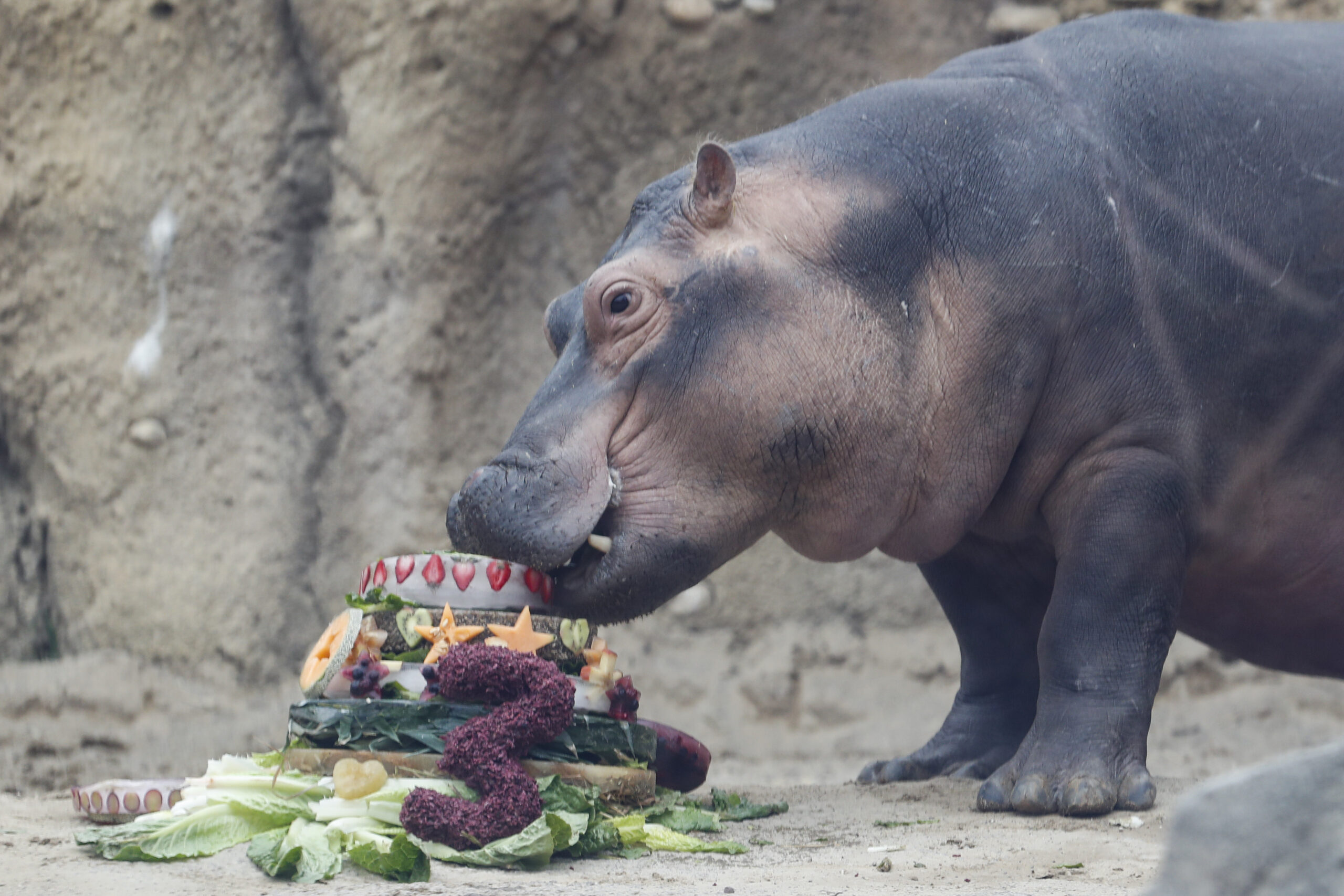
The death of Fiona, a beloved hippopotamus who captured hearts, has renewed calls to remind zoo visitors that animals can die from swallowing foreign objects.
Read more Trump orders federal contractors to check with White House before responding to Congress
Fiona, 9 years old, died Thursday after ingesting a hat that accidentally ended up in her habitat at the Cincinnati Zoo. The zoo said that the hat was lodged in the hippo’s small intestine and surgery was not possible.
“Our animal care team was heroic in their efforts to save her. They did everything possible, but her body couldn’t fight anymore,” Cincinnati Zoo Director Dave Jenike said in a statement.
While deaths are rare, items such as coins, shoes and sunglasses frequently fall, and sometimes are tossed, into animal enclosures.
In 2024, 70 U.S. coins were successfully removed from an alligator at Omaha’s Henry Doorly Zoo and Aquarium. And in 2025, a Komodo dragon ate a shoe that was thrown into its habitat at the Memphis Zoo. The shoe was removed and the dragon survived.
Dr. Gabriella Flacke, an associate veterinarian at Zoo Miami, said the zoo’s staff have retrieved items such as cellphones from alligators.
“We’ve had to remove those items both endoscopically, which is basically putting a camera through the mouth and down into the stomach to grab and retrieve those items, or we’ve in a few cases had to do surgery where they were larger items that couldn’t be removed that way,” Flacke told NPR.
Recovering items from an alligator is easier than a hippo, she said. Unlike the alligator, which has a digestive system with one stomach divided into two parts, hippos have a multichambered stomach. This can make retrieving objects, such as the small hat that Fiona ingested, difficult, according to Dr. Jen Quammen, president of the American Veterinary Medical Association.
Read more Anthropic says it will put humanity first. Will its IPO change that?
“It’s not necessarily always the shape or size of the object, but it’s maybe the twists and turns, metaphorically and physiologically, that things have to go through,” Quammen told NPR.
Be aware that the animals have specialized dietary needs and requirements that caretakers provide them, Flacke said. She also asked visitors to follow zoo etiquette and not yell or throw objects at the animals.
“Anything that we bring that could inadvertently end up in the animal exhibit or somehow around the animal, try to just be mindful and not have your sunglasses on your head if you’re leaning over and looking at something,” she said. “If your child has a toy in its hand and you’re walking around, it could just decide to throw the toy, whether it’s thinking about that or not.”
Both Quammen and Flacke said people should not only be mindful of items that can harm animals at the zoo, but also what could hurt animals in the wild or pets at home.
Animals explore the world by putting things in their mouths, making them naturally curious about items that can be dangerous, Quammen said.
To help prevent an animal from ingesting something dangerous, one should dispose of their trash and properly store items such as human medicines in a place where an animal cannot reach it.
“Don’t feed an animal without permission and that includes our pets at home, but also wildlife,” added Quammen.
Read more An effort to circumvent the Electoral College may be within reach. But hurdles remain